What are the succulent plants?
If you are looking to transform your garden with exotic looking plants that are not only attractive but require low maintenance, then succulents are the plants for you.
These species of plants were first found in the arid
desert regions of the world, and popularly known to resist droughts and harsh
temperatures. This is done by storing water in their thick fleshy steams and
sap-like-leaves; hence the name succulent was derived.
Spread across various dry locations, succulent plants
come in diverse ranges, classified by their exceptional features.
With various species found in the succulent family,
plant enthusiasts can rest assured that they can choose from a wide array of succulents
to successfully convert their indoor or outdoor space into an evergreen paradise.
But how do you choose which succulent type is best for
your garden? In that aspect read on to find out the various succulent classifications
and how to care for them.
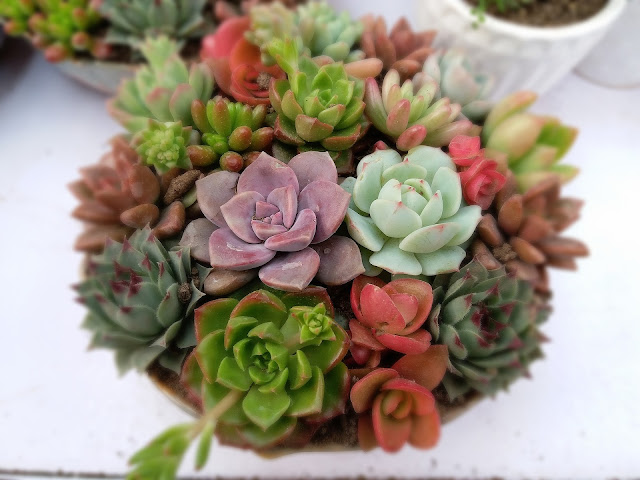
1. Aeonium (Tree Houseleek)
Aeonium is a flowering succulent that comes from the
family of Crassulaceae. There are over 35 known species of Aeonium found in the
subtropical regions.
Popularly known as tree houseleeks among succulent
gardeners, this plant grows up to 2-3 feet tall when it reaches full maturity.
These plants prefer well-drained soil like sandy loam
mixed with succulent potting mix. They grow well in slightly acidic soil with a
ph of 5.5 - 6.0.
To get the idle sun exposure for Aeonium succulents,
you can keep them in full sun and move them to partly shaded areas during
summer months.
Some of the popular varieties of Aeonium that you can
find in garden shops are Mountain Rose, Dwarf Aeonium, Stalked Aeonium and
Emerald Ice to name a few.
2. Agave (Century plant)
Looking for a show-stopping succulent variety for your
front yard? Agave succulents can provide you just that. With their elongated
broad fleshy leaves and pointed tips, these perennial plants can bring the wow
factor to your garden.
Agave commonly called Century plant or American Aloe
has over 270 varieties in the world. They can be distinguished by their vibrant
greenish-blue or grayish-blue colors.
Native to Mexico and other arid parts of South
America, Agave’s grow up to 1-20 feet tall and 1-10 feet in width, depending on
the variety.
You can use well-draining soil mix such as rice hull
or peat moss mixed with other succulent potting mix to boost their growth.
Some of the varieties of Agave succulents are Agave
Blue Glow, Royal Agave, Century plant, etc.
3. Aloe
(Aloe Vera)
Aloe is type of succulent variety that is famous not
only for its aesthetic value it can bring to the home but also for its immense
medicinal properties.
Belonging to the Asphodelaceae family of succulents,
it has 500 more species. Aloe is an evergreen perennial that grows in arid and
tropical climates.
If you are
looking for less maintenance plants that come with heaps of natural health
benefits, Aloe is the plant for you.
It requires less watering as it has the ability to
store water in its fleshy steams. With proper care they can reach up to 25-40
inches in height.
This succulent enjoys full sun to partial shade during
intense heat. You can place them on your window sill to gather much needed
aeration and sunlight.
Some varieties found in the Aloe species are Aloe
Caesia, Tiger Aloe, Coral Aloe and many more.
4. Crassula
Crassula variety is one of the most sort after succulent
plants because of its shrub like plant growth. There are around 200 types of
this species around the world, including the popular household succulent Jade
plant (Crassula Ovata)
If you prefer your succulents to be low maintenance,
then Crassula succulents can be your top contender. Because they require less
watering and can easily adapt in any pots and containers of your choice.
They can be distinguished by their dark green and
green-grey colored leaves. With thick fleshy leaves and stems they form a shrub
like plant growth that sets it apart from other succulents.
They grow well in balanced or slightly acidic soil.
With proper care and maintenance, your Crassula can grow up to 5 feet tall in
its mature size.
It includes various types; some of them are Rattail
Crassula, Crassula falcate, Crassula helmsii, etc.
5. Echeveria
Belonging to the Crassulaceae family of succulent
plants, there are around 150 known species of Echeveria. They are short
flowering succulents with waxy, thick leaves.
They are also called as hens and chicks because of its
distinctive feature where new offsets grow in a cluster around the mother
plant. This cluster forms intricate rosettes, hence called hens and chicks.
When Echeveria reaches maturity, they can tend to grow
up to 3-5 inches tall. You can boost their growth by using well-draining soil
like peat moss along with regular succulent potting mix.
You can maintain the ph for Echeveria by keeping them
at 6.0, as they prefer slightly acidic soil. They grow well in full to partial
sun.
Some of the varieties are Echeveria colorata,
Echeveria affinis, and Echeveria elegans to name a few.
6. Euphorbia
Euphorbia is diverse flowering succulents with a
whooping 2000 species; of those 275 are flowering succulents. It belongs to the
Spurge family and native to the tropical areas of the African region.
They come in broad leaves with spikes covering its
stems. If you are looking for a succulent to spread across your fence, then Euphorbia
can be used to ward of any external elements with its sharp spike like steams.
Euphorbia’s main features are its vibrant flowers that
come in white, pink, red, orange and yellow. With sufficient nutrients and
fertilizers, it can grow up to 5 feet tall.
This hardy succulent can be best grown in
well-draining potting soil mix, with addition of nutrients that provides a
neutral to slightly acidic and alkaline soil.
Types of Euphorbia species are Crown of thorns, Pencil
cactus, and African milk tree to name a few.
7. Gasteria
Gasteria is an evergreen perennial type of succulent
that belongs to the Asphodelaceae family. Native to South Africa and other arid
regions, this succulent is popularly known as Mother-in-laws tongue or snake
plant.
Gasteria’s common names are termed as such because of
its elongated hard and broad leaves, which resemble a tongue shape.
They can be identified by their dark green leaves with
yellow stripes. This variety of succulent flowers during winter to spring and
comes with brilliant colors of red and pink.
Gasteria’s can reach up to 4-24 inches tall, provided
with soil rich nutrients such as perlite, compost and other potting mix.
To get these succulents looking healthy, you can try
maintaining the soil ph value of 6 - 7.
Varieties of this species of succulent include
Gasteria carinata, Gasteria polita, and Gasteria batesiana, etc.
8. Graptopetalum
Native to Arizona and Mexico, this perennial succulent
belongs to the Crassulaceae plant family. With over 19 known species, it is
commonly termed as mother-of-pearl.
Graptopetalum is also popularly known as ghost plant,
because of its eerily looking opaline leaves with greyish- white hues.
This succulent comes in a star shaped fleshy leaves
that turns to bluish-grey color when kept in shade.
Graptopetalum prefers a neutral to slightly acidic ph
in the soil that ranges from 6.1-7.5.
Some of the diverse varieties are Graptopetalum
bellum, Graptopetalum amethystinum, and Graptopetalum macdougalii, etc.
9. Haworthia
Haworthia is small group of succulents that belongs to
the Ashodelaceae plant family. It is the same family as Aloe, with around 160
varieties.
This evergreen perennial grows as a rosette-like
leaves that are wide and fleshy. These short succulents can grow up to 3-5
inches tall, with some even reaching 20 inches.
Some variety of Haworthia requires less sunlight,
while others require full sun.
Haworthia develop well in soil rich with nutrients
such coco peat or compost. They prefer a neutral ph value in the soil.
Few varieties of Haworthia succulents are Howorthia
Cooperi, Howorthia truncata, Howorthia retusa, etc.
10. Kalanchoe
Kalanchoe is a household succulent, belonging to the
Crassulaceae family and subfamily of Kalanchoideae. Scientists have found
around 125 species that are native to tropical regions of Africa.
Kalanchoe is popularly grown as a household plant
because of its multicolored flowers. The blooming season starts in winter to
late spring that bears flowers of yellow, red, orange, pink and white.
Like many of the other categories of succulent, this
one too prefers soil containing succulent potting mix with addition of peat
moss and perlite. Acidic ph of soil can be of the range 5.8-6.3.
You can find various types of Kalanchoe, some of them
are Kalanchoe pinnata, Kalanchoe delagonsis, Kalanchoe thyrsiflora, etc.
11. Sedum
Sedum variety of plant which is well-known as a
flowering succulent belongs to the Crassulaceae family. Succulent gardeners extensively use Sedum as
a ground cover.
With over 600 species of Sedum found in the world,
these short delicate succulents spread easily on the ground, covering vast
areas quickly.
They are indentified by their star shaped leaves and
flowers that vary in size depending of the type of Sedum succulents.
With their small size, the tallest succulent reaching
only 3 feet tall, they can be easily maintained and propagated.
In terms of soil, you can try coarse and granulated
particles such as sand and perlite that promote good aeration and nutrients.
Sedum varieties include Sedum stenopetalum, Orpine,
Jenny’s stonecrop and white stonecrop to name a few.
12. Sempervivum
Not to be confused with Echeveria, Sempervivum is a
different category of succulents that also forms rosettes and is called hens
and chicks. It belongs to the Crassulaceae family with Sempervivoideae as
subfamily.
Semervivum are evergreen perennial succulents with
around 40 known species. Distinguished by their glossy rosettes shape and thick
leaves, it can be grown as ground cover.
In its mature size, it can reach up to 3-6 inches tall
and 6-12 inches wide. They grow well when planted in areas with full sun
exposure.
Some of the varieties belonging to Sempervivum type of
succulent are Sempervivum ciliosum, Sempervivum calcareum, etc.
13. Senecio
Senecio belongs to the Asteraceae (daisy) succulent
plant family. This hardy succulent bears flowers that resemble the daisy with
yellow, red or orange colors.
They come is short elongated stems with green-grey
leaves. With proper care they can grow up to 12-18 inches tall and form a dense
shrub-like plant growth.
You can aid their development by using well-draining
soil which has a neutral ph of 6.0-7.0.
Of the many varities of Sencio, some of them are Senecio radicons, Senecio peregrines, Sencio rouleyanus and Sencio herreanus.
There are numerous categories of succulents available in
the world, with each one displaying exceptional characteristics of their own.
With no shortage of succulent types to choose from, you can follow the above succulent classification guide to plant these vibrant species of plants according to your preference.
Very good info, This information will always help everyone for gaining important knowledge about succulent plants. So please always share your valuable and essential information. I am very thankful to you for providing good information. Thanks once again for sharing it.
ReplyDeleteThe content you've posted here is fantastic because it provides some excellent information that will be quite beneficial to me. Thank you for sharing about building a garden box. Keep up the good work.
ReplyDeleteYou have given us very important data. It is excellent and informative for everyone about build vegetable planter box. Keep posting always. I am heartily thankful to you.
ReplyDelete